

August 2026: The Living Dzogchen Tradition Comes to Switzerland
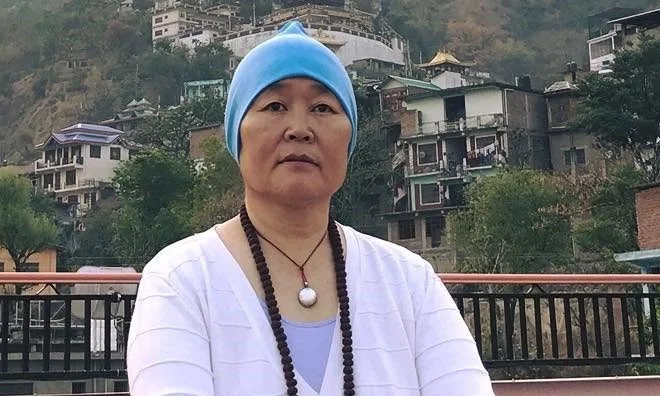
Berne, August 2026 - The Vidyadhara community had the great honour of welcoming the great Dzogchen master and Dakini Khandroma Khachoed Tsering Palmo in Berne at the House of Religions.
Khandroma Khachöd Tsering Palmo realised the Buddhist path of Dzogchen through more than twenty-five years of intensive solitary retreat. She is a heart disciple of H.H. Trulshik Rinpoche, the former head of the Nyingma school of Tibetan Buddhism.
H.H. Trulshik Rinpoche recognised her as the incarnation of Chamsar Akar Salé Drönma («White AH, Radiant Lamp»), who is regarded in the Tibetan tradition as the spiritual consort of King Trisong Detsen and a direct disciple of Guru Rinpoche in the eighth century.
Khandroma is a principal holder of several important Dzogchen lineages, including the Longchen Nyingthig, Düdjom Tersar, and Chetsün Nyingthig, as well as the Seventeen Dzogchen Tantras.
The open question-and-answer session offered a rare opportunity to ask Khandroma questions directly about practice, meditation, everyday life, and the spiritual path, in an atmosphere of presence and warmth.
This was Khandroma only visit to Switzerland.
Berne, August 2026 — The Vidyadhara community had the profound honour of welcoming Khandroma Khachöd Tsering Palmo, the revered Dzogchen master and Wisdom Dakini, to Berne’s House of Religions.
Khandroma has realised the Buddhist path of Dzogchen through more than twenty-five years of intensive solitary retreat. She is a heart disciple of H.H. Trulshik Rinpoche, the former head of the Nyingma school of Secret Mantrayana, who recognised her as the incarnation of Chamsar Akar Salé Drönma («White AH, Radiant Lamp»), the wife and spiritual consort of the 8th century King Trisong Detsen.
Khandroma is a principal holder of several profound Dzogchen lineages, including Longchen Nyingthig and Chetsün Nyingthig, as well as the Seventeen Dzogchen Tantras. Her presence and teachings brought these ancient streams of direct transmission into a living encounter with practitioners in Switzerland.
At the House of Religions, around 110 people gathered to receive her teachings. The following day in Winterthur, a further 40 participants joined an intimate open question-and-answer session, where Khandroma responded directly to questions on meditation, practice, everyday life, and the spiritual path, while also offering practical guidance in meditation.
For those present, this was far more than an encounter with Buddhist philosophy. It was an opportunity to meet a living holder of an ancient contemplative tradition and to receive teachings grounded in decades of practice and realisation.
This was Khandroma’s first and only visit to Switzerland. She gave a special blessing to our centre by giving it the spiritual designation Orgyen Khandro Ling, which means The Sanctuary of the Dakinis of Odyana, and by encouraging practitioners to be diligent in their practice. She also gave Chöying Drolma the spiritual designation Khandro Dukkar, which means The Dakini of the White Parasol. Her presence left a deep impression on the community and created a precious connection to the living Dzogchen tradition that will continue to inspire practitioners for a life-time.
June 2026: Interreligious conference at the vatican, General Audience with Pope Leo XIV.
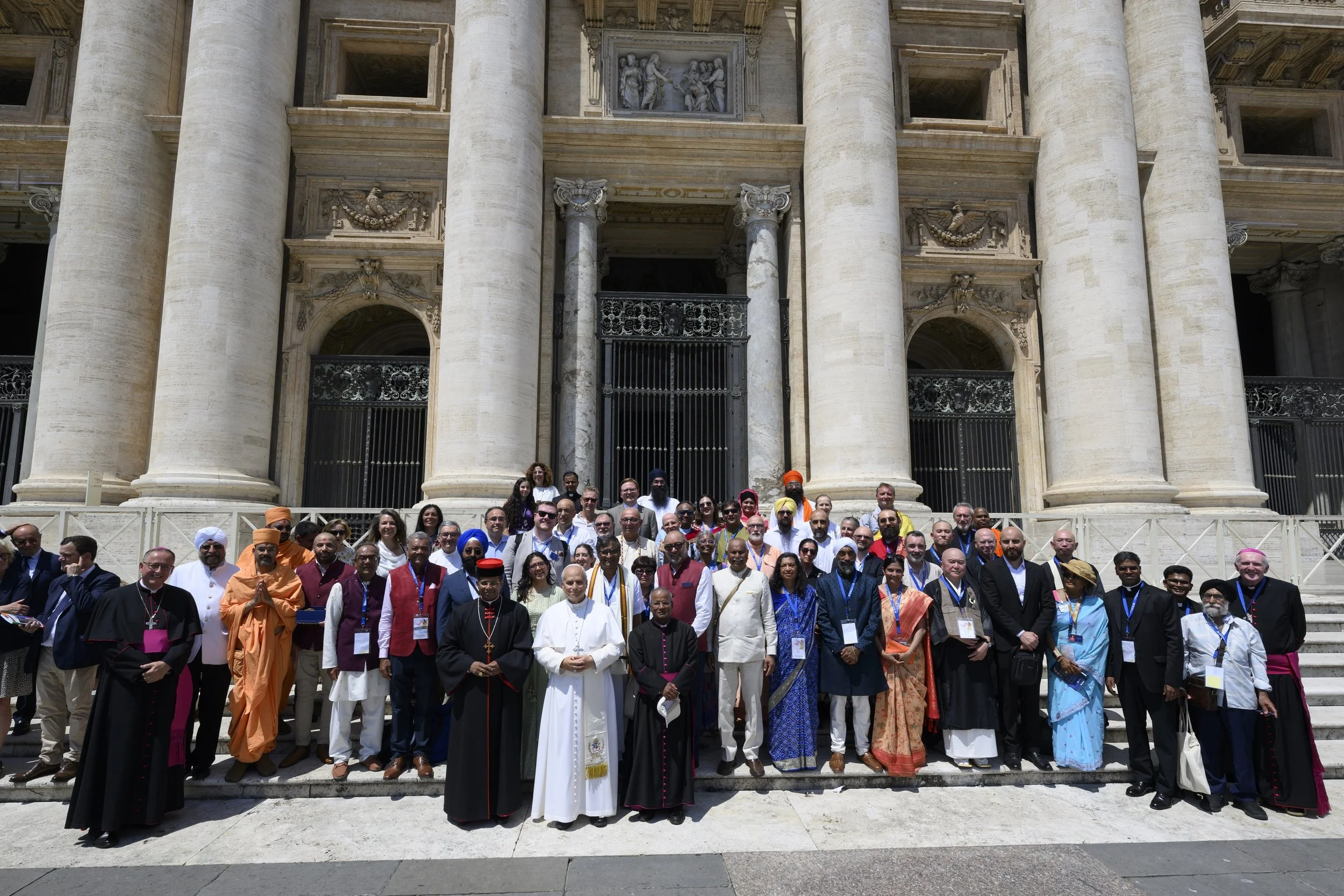
Rome, June 2026 - For more than two millennia, the Eternal City has drawn people from every corner of the world: emperors and pilgrims, scholars and mystics, statesmen and seekers, sinners and saints. Precisely this took place again on 23 and 24 June 2026. At the invitation of the Vatican’s Dicastery for Interreligious Dialogue, representatives of the Dharmic religions and Christianity gathered for a conference entitled “Buddhists, Christians, Hindus, Jains and Sikhs in Europe: Fraternity through Dialogue and Cooperation.”
Fifteen distinct religious and spiritual traditions encountered one another not as competitors, but as fellow travellers in search of cohesion and a common voice in an increasingly fragmented world.
What was particularly striking was the diversity of perspectives. A scholar of the Jain tradition explained the teaching of Anekāntavāda: the insight that reality can never be fully apprehended from a single point of view. A Buddhist teacher spoke of Pratītyasamutpāda, the interdependent arising of all things and the profound interconnectedness of all living beings. From the Hindu perspective, the famous Vedic dictum was explained: “Ekam Sat Viprā Bahudhā Vadanti” — “Truth is one; the wise speak of it in many ways.”
However different the theological approaches may have been, they all pointed towards a common insight: what the world needs today is not uniformity, but a unity spacious enough to embrace diversity.
We need young people who learn to build bridges between religions.
One of the most compelling moments came from the youngest participants. The youth representatives pointed out that interreligious dialogue is still largely carried by men who, even with considerable imagination, could scarcely still be described as belonging to the category of “youth”. If a culture of encounter is to have a future, we urgently need young people who learn to build bridges between religions.
The message struck a chord. The Vatican responded by announcing a dedicated international gathering for youth representatives. Its aim is to nurture the next generation of interreligious leaders. Perhaps this was the most important investment in the future to emerge from the entire conference.
The culmination came with a personal audience with Pope Leo XIV. The group photograph of representatives of such diverse traditions (Lama Sherab Gyatso can been in the penultimate row, on the right side) together with the Holy Father became a powerful symbol of what the world longs for: the heart of the Great Perfection.
During these days, Rome offers a reminder of a timeless truth: unity arises from the ability to cherish differences while nevertheless standing together for what is good and true. Religious and spiritual traditions discover their deepest unity not in identical doctrines or shared conceptions of the divine, but in the mystery of love.
Rome, June 2026 - For more than two millennia, the Eternal City has drawn people from every corner of the world: emperors and pilgrims, scholars and mystics, statesmen and seekers, sinners and saints. Precisely this took place again on 23 and 24 June 2026. At the invitation of the Vatican’s Dicastery for Interreligious Dialogue, representatives of the Dharmic religions and Christianity gathered for a conference entitled “Buddhists, Christians, Hindus, Jains and Sikhs in Europe: Fraternity through Dialogue and Cooperation.”
Fifteen distinct religious and spiritual traditions encountered one another not as competitors, but as fellow travellers in search of cohesion and a common voice in an increasingly fragmented world.
What was particularly striking was the diversity of perspectives. A scholar of the Jain tradition explained the teaching of Anekāntavāda: the insight that reality can never be fully apprehended from a single point of view. A Buddhist teacher spoke of Pratītyasamutpāda, the interdependent arising of all things and the profound interconnectedness of all living beings. From the Hindu perspective, the famous Vedic dictum was explained: “Ekam Sad Viprā Bahudhā Vadanti” — “Truth is one; the wise speak of it in many ways.”
However different the theological approaches may have been, they all pointed towards a common insight: what the world needs today is not uniformity, but a unity spacious enough to embrace diversity.
We need young people who learn to build bridges between religions.
One of the most compelling moments came from the youngest participants. The youth representatives pointed out that interreligious dialogue is still largely carried by men who, even with considerable imagination, could scarcely still be described as belonging to the category of “youth”. If a culture of encounter is to have a future, we urgently need young people who learn to build bridges between religions.
The message struck a chord. The Vatican responded by announcing a dedicated international gathering for youth representatives. Its aim is to nurture the next generation of interreligious leaders. Perhaps this was the most important investment in the future to emerge from the entire conference.
The culmination came with a personal audience with Pope Leo XIV. The group photograph of representatives of such diverse traditions (Lama Sherab Gyatso can been in the penultimate row, on the right side) together with the Holy Father became a powerful symbol of what the world longs for: the heart of the Great Perfection.
During these days, Rome offers a reminder of a timeless truth: unity arises from the ability to cherish differences while nevertheless standing together for what is good and true. Religious and spiritual traditions discover their deepest unity not in identical doctrines or shared conceptions of the divine, but in the mystery of love.
- Lama Sherab Gyatso
October 2025: Interreligious Celebration with the New Pope Leo XIV.
May the Great Perfection be with You
Report about the 60th Anniversary Celebrations of Nostrae Aetate, Vatican City, October 28, 2025
In front of St. Peter’s Basilica, incense mingles with autumn air. Reporters press between rabbis, Dharma scholars, imams, monks, and cardinals. Sixty years after Nostra Aetate, the groundbreaking declaration of the Second Vatican Council, the world returns to the place where the Church first learned not to fear the unfamiliar.
Yet the sky above Rome feels heavy. Antisemitic attacks, anti-Muslim slogans — they hang over the anniversary like a silent storm. “It feels as if Nostra Aetate is being tested once again,” murmurs a theologian. In the corridors of the Vatican, tensions hum. The wounds of world politics are fresh, the divisions deep.
By evening, the Paul VI Hall fills with the songs of young people from five continents. Hebrew, Sanskrit, Latin — voices intertwine like prayers of a single humanity. The artists honour every faith in turn, weaving light, rhythm, and reverence into one shared offering. When they reach Buddhism, they raise the signboard of a Dharma wheel up with their arms and dance to it, as if to awaken the vibration of the Dharma itself.
Later, Pope Leo XIV steps before the delegates. No grand staging, no sceptre’s shine — only the quiet dignity of a humble man. “Dialogue is not a tactic or a tool,” he says. “It is a way of life — a path of the heart that transforms all who participate in it.” His words do not echo and fade; they settle like rain on thirsty soil. “Sixty years ago, a seed of hope was planted,” the Pope continues. “Today your presence shows that it has grown into a mighty tree. Nostra Aetate reminds us of what unites us: we belong to one human family — one in origin, one in goal.”
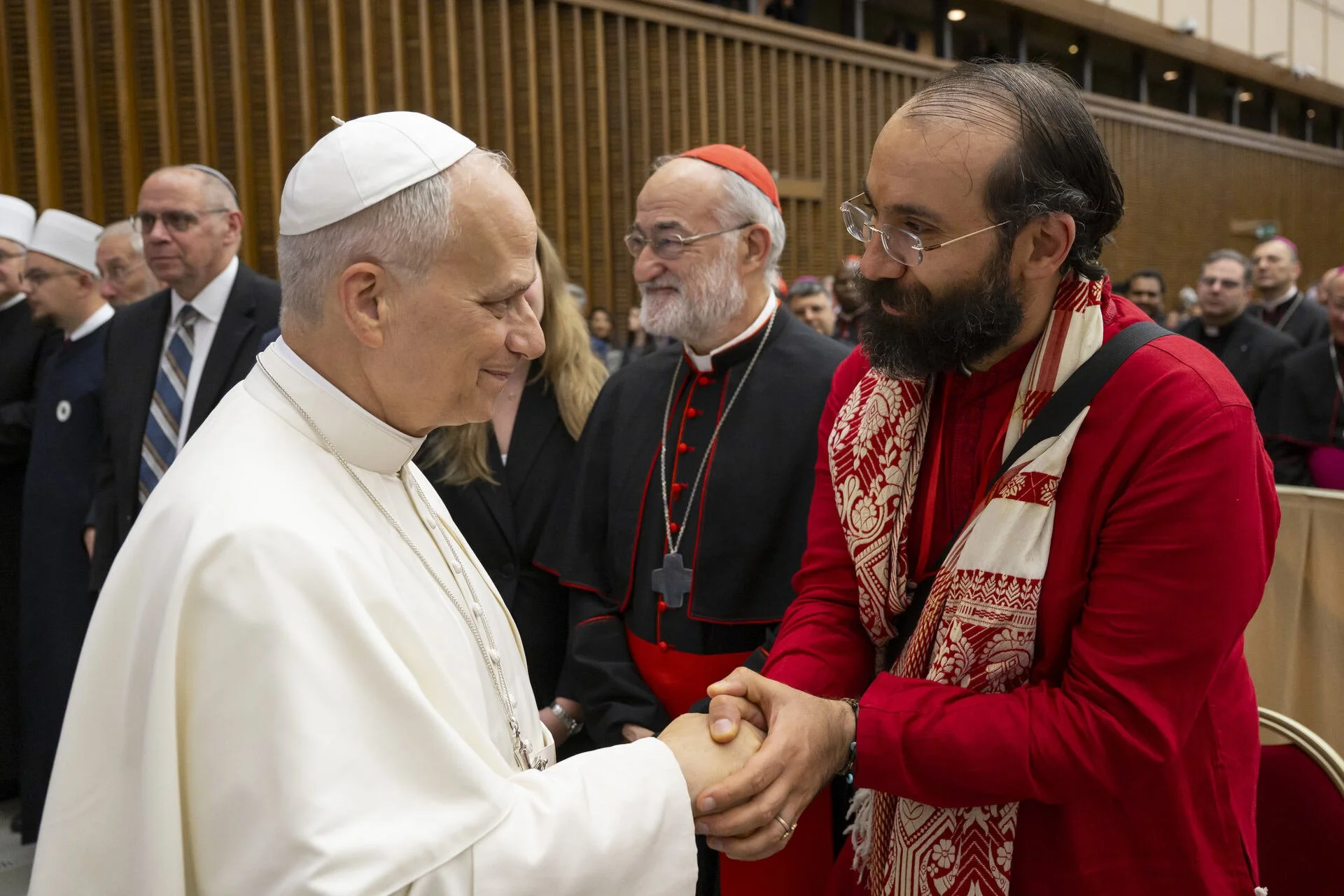
The sixty representatives of the world’s religions rise. The Pope descends the steps, walking calmly through the rows, shaking each of our hands. No escort, no protocol — only his gentle, human gaze. I bow my head and say softly, “May the Great Perfection be with you.” He looks slightly surprised, then smiles. “Thank you,” he says. I hand a cardinal a stone from Mount Kailash — for billions of Buddhists, Hindus, Jains, and Bön practitioners the navel of the world, abode of ultimate reality, the divine father and mother of all beings. The cardinal, visibly moved, promises to tell the Holy Father its meaning.
In that moment, Nostra Aetate is no longer a document but a living presence — the quiet language of love that reveals itself through understanding. Beneath the vast dome of St. Peter’s, the evening light flows like liquid gold across marble walls. Beside me, a rabbi’s wife murmurs that her husband, for the first time in decades, fears wearing his kippah in public. For a long moment, everything within me falls silent. I am deeply shaken. Rome, in these days, is no symbol of perfect unity — but the place where unity begins again, every single day.
Sixty years after Nostra Aetate, its message feels more fragile — and more vital — than ever: True dialogue urgently calls for the humility of the heart.
- Lama Sherab Gyatso
May 2023: Interreligious Meeting at the Vatican with Pope Francis
Universal Kinship
The mere thought of meeting the Pope fills the heart with anticipation and reverence. In the days leading up to the encounter, it is impossible not to feel a mixture of excitement and nervousness.
I arrive in Rome on 1 May and am met at the airport by a Vatican driver. Ricky Martin is playing on the radio. I am taken to the Domus Romana Sacerdotalis, a charming guesthouse for visitors to the Vatican from all over the world. One does not often have breakfast with a bishop, let alone the president of a bishops’ conference. Here, it is an everyday occurrence.
In a world marked by religious diversity, fostering interreligious dialogue and understanding is of vital importance if we are to build bridges and promote harmonious coexistence. Why am I in Rome? On 2 May, the Vatican’s Dicastery for Interreligious Dialogue is organising a conference on a New Humanism under the motto “Fratelli Tutti” – “We are all brothers and sisters”.
That evening, there is an aperitif. It is opened by Cardinal Miguel Ángel Ayuso Guixot, Prefect of the Dicastery. Theologians and scholars, professors and scholars of religion from around the world – from Oxford, Munich, Heidelberg and Fribourg – introduce themselves. The sense of anticipation is palpable. By creating spaces for dialogue, the gathering seeks to foster compassion and mutual understanding.
Dinner is somewhat meagre. The chef takes the word “vegetarian” rather literally. We are served, quite literally, nothing but vegetables for dinner. Fortunately, there is still room afterwards for some Vatican gelato. Breakfast the following morning is somewhat more substantial.
The next morning, 55 participants gather in the conference room of the Dicastery, with simultaneous interpretation provided in several languages. However, only 15 people are permitted to speak. The Cardinal opens with a fascinating address in which he describes Pope Francis’ vision of “Fratelli Tutti”. He speaks of how the Pope quoted the Upanishads in one of his speeches. He speaks of Dharma – the Sanskrit umbrella term for the spiritual path. He speaks of how Eastern spirituality can enrich the Christian understanding of spirituality.
A scholar of religion strikes a somewhat more sober note, emphasising that interreligious encounters offer practitioners the opportunity to develop meaningful and respectful relationships. Yet for this to happen, people from various traditions must be willing to engage in open and honest conversation.
I speak about non-duality. The word “Catholic”, after all, originally means universal, all-encompassing. Why, then, should there be “insiders” and “outsiders” for Catholics? I emphasise that the non-dual understanding can strengthen the Catholic Church in its original Catholicity – its universality. I speak of the Dakini, the Motherly aspect of the Divine, as the innate love and bliss dwelling naturally within all living beings.
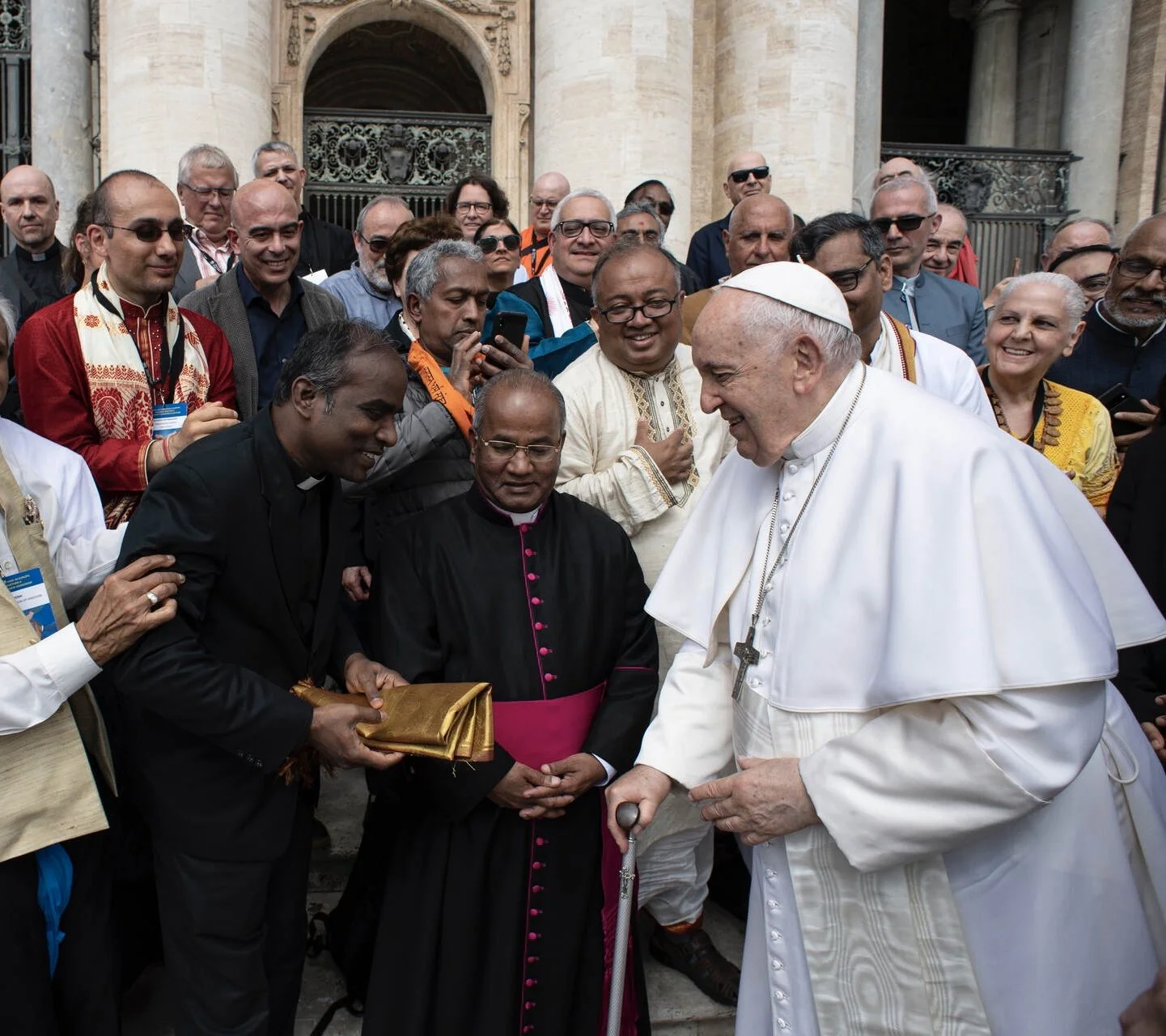
The encounter with the Pope the following morning is brief, yet its impact is profound. His eyes, reflecting a depth of wisdom and compassion, seem to reach deep into the soul. The Pope’s warm smile and gentle touch convey a sense of unity and love. I ask him to bless my mālā – my prayer beads.
In the Vatican Gardens, I discover an ancient spring dating back to Roman-Greek times, and a pine cone flanked by peacocks. In her manifestation as Juno, the Divine Mother continues to bless the Vatican from within.
- Lama Sherab Gyatso