


The Dzogchen Nyingthig Vidyadhara Centre
The Centre
The Founding of the Centre
On 27 July 2017, our revered Root Guru, the great tertön (treasure revealer) Gyurme Ngakrabtsal (AR), also known as Akshara Munishasa Samudra, made the auspicious request that Sherab Gyatso and his Dharma friends establish a centre in Switzerland dedicated to the preservation, transmission, study, and practice of the profound non-dual teachings of his ancient Atiyoga, or Dzogchen, tradition and lineage.
During the week of teachings that followed, he bestowed an exceptionally extensive and detailed commentary on the Dzogchen Longchen Nyingthig, providing the students with the essential preparation and foundation for entering the profound practices of Dzogpachenpo, the Great Perfection.
On 23 April 2018, he formally bestowed upon the centre the name Dzogchen Nyingthig Vidyadhara, meaning “Awareness-Carrier of the Heart Essence of the Great Perfection”. The name expresses the centre’s fundamental aspiration: not merely to preserve a body of teachings, but to uphold and sustain their living transmission through study, practice, realisation, and continuity within the lineage of the Vidyadharas.
In February and March 2019, Gyurme Ngakrabtsal, or Akshara Munishasa Samudra (AR), bestowed a further series of profound and extensive wang, lung, and tri teachings. These transmissions encompassed numerous treasure cycles of his own revelation, as well as the cycles of A.dzom Drukpa.
During this period, he transmitted to the Vidyadhara Centre a vast array of elaborate abhiṣeka or wang empowerments, including those of Yeshe Tsogyal, Thröma Nagmo, Guru Drubthab, Manjushri, his own Avalokiteshvara terma from the Pema Nyingthig cycle, Vajrakilaya, and his own Guru Yoga of the Vine of Faith, together with an extensive commentary on its practice. He also transmitted Dharmakaya Phowa, Orgyen Dzambhala, and the One Hundred Peaceful and Wrathful Deities of his Zhitro terma, alongside numerous other practices drawn from his Secret Mantra revelations, including, for example, his Ekajati terma.
During the same period, he transmitted profound and secret teachings on Tsa Lung, as well as the main practice of the Longchen Nyingthig cycle: Cutting through to Primordial Purity (Trekchö) and Leaping Over with Spontaneous Presence (Tögal). He further revealed and transmitted his own treasure teachings connected with the main practice, thereby deepening and enriching the centre’s living inheritance of the Dzogchen lineage.
On 8 March 2019, aftering bestowing upon him the sacred Vajrācārya empowerment, he asked Sherab Gyatso to develop a systematic, step-by-step programme of training for students. He instructed that the programme should provide students with clear and progressive guidance concerning the various Dzogchen practices to be cultivated and perfected, while ensuring that the instruction and guidance offered to each individual could be adapted according to their particular inclinations, capacities, and stage of advancement. After several years of retreat, Sherab Gyatso began to offer Natural Radiance in 2024, fulfilling Akshara Muni Shasa Samudra’s (AR’s) vision.
On 14 November 2019, one of the centre’s students was granted a personal audience with His Holiness the Great Chenrezig. During this most auspicious and divine encounter, His Holiness bestowed his blessings upon the centre and, in particular, expressed the wish that the Bodhisattvacaryāvatāra be taught directly from the original Sanskrit. This blessing and instruction provided a profound encouragement for the centre’s commitment to rigorous engagement with the classical sources of the Dharma and to preserving their transmission in their original languages.
Between 2019 and 2025, Akshara Munishasa Samudra (AR) offered transmissions to the centre through teleconferences, including on the Longchen Nyingthig, the Noble Tara, Avalokiteshvara, as well as elaborate teachings on Phowa or Transference Consciousness, and a number of other transmissions.
In June 2025, Akshara Munishasa Samudra (AR) bestowed the wang, lung, and tri of three particularly profound cycles: Yangsal Lhadrub Thiglé Gyachen, the innermost secret Guru Yoga of the Longchen Nyingthig; Yumka Dechen Gyalmo or Yumka Queen of Great Bliss, the innermost secret Dakini of the Longchen Nyingthig; and his own Dzogchen Manjushri, revealed from his own treasure cycle.
On 10 June 2025, after asking Sherab Gyatso to officially use the traditional Lama title in serving the holy Dharma, Rinpoche spoke the following words about the centre:
“Rinpoche has predictions that his teachings will spread very far, and so your students are going to become very powerful and have this power in them. Don’t be ordinary.”

The short footpath up to the Centre.

A side view of the Dzogchen Nyingthig Vidyadhara Centre.
About our Root-Guru
Our Root-Guru Gyurme Ngakrabtsal (AR) — Akshara Munishasa Samudra — is a widely renowned Dzogchen master, a tertön or treasure revealer, and considered by many Dzogchen masters to be a Mahāsiddha. Together with his wonderful sister, who is considered by many great masters and yogīs to be an emanation of the Goddess Tārā, he runs a picturesque monastery and retreat centre in the lofty mountains of Eastern Tibet. The monastery is named after the great tāntric seat of Odyāna, birthplace of the great master Padmasambhava, 8th century CE.

The primordial syllable representing the Root-Guru
Lama Sherab Gyatso
Lama Sherab Gyatso, also known as Acharya, is a direct disciple and lineage-holder of Akshara Munishasa Samudra (AR), the Root-Guru of our Dzogchen Nyingthig Vidyadhara Centre. At his Root-Guru’s behest, his teaching and practice are grounded in the living transmission of Dzogpachenpo, while drawing upon a broad and deeply rooted education in the Buddhist, nondual and tāntric traditions of ancient India.
In 2019, AR bestowed upon him the Vajrācārya, or teacher's, empowerment. In 2025, following a personal meeting, AR formally authorised him to teach publicly under the traditional title Lama. On that occasion, Rinpoche also spoke of Lama Sherab Gyatso's particular connection with Mañjuśrī and his karmic connection with AR's own Dzogchen Mañjuśrī terma cycle.
Born in Switzerland in 1984 to a family of mixed heritage, Lama Sherab Gyatso began his traditional Indian education at the age of twelve at Śrī Kailāś Āśram in Rishikesh, where he entered monastic training as a novice during his early teenage years. There he received a rigorous grounding in the classical disciplines of the Indian intellectual and contemplative traditions: Pāṇinian Sanskrit grammar, logic and debate, and the study of the Upaniṣads and their traditional commentaries under the renowned scholar Śrī Svāmī Vidyānanda Giri. Alongside this education, he studied the Buddhist Tipiṭaka with Buddhaghosa’s commentary in the original Pāli.
During this period, at the age of fifteen, he was granted his first personal audience with His Holiness the Great Chenrezig, an extraordinary encounter that lasted nearly two hours during which he was permitted to remain in the Great Chenrezig’s presence at a distance of approximately fifty centimetres for the entire time. On this memorable occasion, he was allowed to recite before the Great Chenrezig a series of ancient Sanskrit hymns concerning the profound meaning of nirvāṇa. Deeply pleased by his recitation, the Great Chenrezig offered his blessings and encouragement for the young student’s continued study of Sanskrit and cultivation of nondual wisdom, affectionately pinching his cheeks many times in a gesture of infinite love and blessing.
Lama Sherab Gyatso’s education during this time extended beyond a single religious or philosophical tradition. He had the opportunity to learn from distinguished Indian scholars and masters of Advaita Vedānta and nonduality, including practising the ancient tāntric system of Śrīvidyā and the yogic system of Kriyāyoga from the age of 14. He later also received his foundational training in Mahasi Sayadaw’s Vipassanā under the guidance of the renowned Theravāda Buddhist master Ajahn Tong Sirimangalo.
At eighteen, he returned to Switzerland, where he studied comparative religion and theology at the University of Fribourg, completing an M.A. He subsequently did his doctoral studies in Cultural Studies and Psychology.
This unusual breadth of training continues to inform his teaching today. Lama Sherab Gyatso teaches Sanskrit, meditation and Atiyoga in Switzerland, bringing together a rigorous knowledge of the classical Indian sources with the direct contemplative orientation of the Dzogchen transmission he received and continues to receive from Akshara Munishasa Samudra (AR).
His literary work reflects the same commitment to returning to the primary sources. Over the years, he has authored and translated a number of works, including a fresh translation of Patañjali's Yogasūtras, published in a signature edition illustrated by a South Indian artist, as well as works on the Bhagavad-Gītā, the Rāmāyaṇa and the Guru-Gītā, published by Nightingale.
He is currently completing a series of major translation projects from the Buddhist and Indo-Tibetan traditions, including fresh translations of the Lord Śākyamuni’s Dharmapada, the Noble Śāntideva's Bodhisattvacaryāvatāra, the Noble Kamalaśīla's three Bhāvanākramas or Stages of Meditation, the Noble Atīśa's Bodhipathapradīpa or Lamp for the Path to Enlightenment, the Noble Nāgārjuna's Mūlamadhyamakakārikā or Fundamental Verses on the Middle Way, Shabkar Tsokdruk Rangdrol's Flight of the Garuda, and a large-scale translation project: The Seventeen Dzogchen Tantras, among others. These works are scheduled for publication in 2026 and 2027.
Alongside his spiritual service, at an outermost level, he has been drawn into the field of interfaith dialogue. Since 2023, he has represented the Dharma at the Vatican on four occasions. Since 2024, he has also served as a member of the United Nations’ Faith for Rights Expert Group, convened under the auspices of the Office of the United Nations High Commissioner for Human Rights in Geneva, where he formally contributes and represents the perspectives of the Dharmic traditions.
The Dzogchen Path
Before entering the Dzogchen path under the guidance of AR, Lama Sherab Gyatso had already spent many years studying the great philosophical and contemplative traditions of India. His encounter with AR's Atiyoga transmission, however, brought these diverse streams of knowledge into an entirely different perspective.
He describes Atiyoga as a living transmission of nondual wisdom: a direct continuation of ancient Indo-Tibetan contemplative traditions whose purpose is not merely to develop a philosophical understanding of reality, but to recognise and fully actualise one's own primordial nature.
For him, Dzogchen is distinguished by the extraordinary directness of its approach. Rather than constructing a conceptual understanding of reality and gradually attempting to approach it through increasingly refined states of mind, Atiyoga points directly to what is already present: the primordial purity and luminous clarity of awareness itself.
His approach is experiential, rigorous and non-sectarian. His extensive engagement with Hindu, Buddhist and tāntric sources has reinforced his conviction that the great Dharma traditions, despite their profound doctrinal differences, illuminate a common dimension of nondual insight. He therefore approaches them neither by collapsing their distinctions nor by placing them into a superficial syncretism, but by allowing each tradition to speak from within its own authentic philosophical and contemplative framework.
Within this wider field, he holds Dzogchen in the highest regard for the exceptional directness of its view and practice: its emphasis on non-conceptual recognition, effortless presence, unconditional compassion, extraordinarily refined methods and the clarity of its fruition.
At AR's request, Lama Sherab Gyatso began teaching and transmitting the Dharma in Switzerland in 2017, adapting the manner and depth of his teaching to the capacity, experience and disposition of individual students.
His role today is therefore not simply that of an academic scholar, translator or teacher of comparative religion. His work brings together classical Indian scholarship, Buddhist and Secret Mantra contemplative traditions, Sanskrit textual transmission, and the direct experiential path of Dzogchen Atiyoga.
At the heart of this work remains the transmission he received from his Root-Guru AR: a living path pointing beyond conceptual elaboration to the recognition of one's own primordial nature as primordially pure, naturally luminous awareness.
Chöying Drolma
Chöying Drolma is a traditional Nāṭya and Lāsya practitioner, teacher and embodiment of the sacred feminine, and the mother of the Dzogchen Nyingthig Vidyadhara Centre. With the blessings and guidance of AR, she teaches Ḍākinī Movement and Mudrās, together with the traditional movement practices of the Adzom Drukpa lineage known as Trul Khor.
Her work emerges from an understanding of the body that is deeply rooted in the contemplative traditions of India and Tibet. The body is not regarded as something separate from awareness, nor merely as an instrument through which the mind expresses itself. It is an energetic manifestation of the primordial unity of stillness and movement: the unchanging ground of awareness expressing itself dynamically through breath, posture, gesture, rhythm and embodied presence. Movement therefore becomes a means of recognition.
Through attentive movement, the practitioner learns to inhabit the body more completely, to discover the intimate relationship between awareness and energy, and to allow habitual emotional patterns to move without suppression or fixation. Emotions need not be regarded as obstacles to spiritual practice. When met directly through embodied awareness, they can be released from habitual patterns of grasping and resistance and allowed to reveal their original purity, vitality and purpose.
This is at the heart of Chöying Drolma's approach: movement is not performed merely for its external beauty or physical benefit. It becomes a contemplative language through which body, energy and awareness are brought into intimate correspondence.
With more than twenty-five years of experience, Chöying Drolma draws upon the ancient classical Indian tradition of Lāsya, the graceful and expressive dimension of sacred temple dance, in which devotion and contemplation are embodied through movement, rhythm and gesture. In this tradition, the body itself becomes an offering. Gesture becomes language; movement becomes prayer; and the dancer becomes both the practitioner and the vessel through which the sacred is expressed.
Central to this work are mudrās, the precise and symbolically rich hand gestures through which qualities of awakened presence are embodied and communicated. Chöying Drolma particularly emphasises the sacred feminine dimension of these practices, drawing upon the imagery and symbolic language of Ḍākinīs and Bodhisattvas. Here, the feminine is not treated merely as an aesthetic category, but as a dynamic expression of wisdom, receptivity, vitality and enlightened activity.
Her teaching includes powerful traditional movement sequences such as the Birth of Tārā and AR’s Lotus Dance, in which narrative, symbolism, gesture and embodied awareness come together. Through such practices, participants encounter the sacred not solely as an idea to be contemplated, but as something that can be felt, embodied and expressed through the entire field of the body.
Alongside these classical Indian forms, Chöying Drolma teaches the traditional Trul Khor movement practices of the Adzom Drukpa tradition. Within the Dzogchen path, such practices work with the relationship between body, breath, movement and awareness, using the body as a gateway into a more immediate recognition of its natural state.
Her approach therefore occupies a distinctive meeting point between the Indian and Tibetan contemplative worlds: between Nāṭya and Trul Khor, Lāsya and Dzogchen, mudrā and embodied awareness. The outer form may be movement, gesture or dance; its deeper purpose is to discover what becomes apparent when movement arises within stillness and stillness is recognised within movement.
In 2026, the great Dzogchen master Khandroma Khachöd Tsering Palmo — who was the Queen of King Trisong Detsen in the eight century — on a visit to the Vidyadhara centre, bestowed upon Chöying Drolma the designation of Khandro Dukkar, The Dakini of the White Parasol.
The Circle of Practice
In their work at the Dzogchen Nyingthig Vidyadhara Centre, Lama Sherab Gyatso and Chöying Drolma are supported by a dedicated group of practitioners whose contribution is essential. Among them are Changchub Döndrub, Dechen Nyima, and Namkha Drolma, who contribute their time and energy to the organisation and practical support of retreats and teachings.
Their work behind the scenes helps create the conditions in which the teachings, retreats and practices of the Centre can be offered and sustained.

Chöying Drolma and Lama Sherab Gyatso
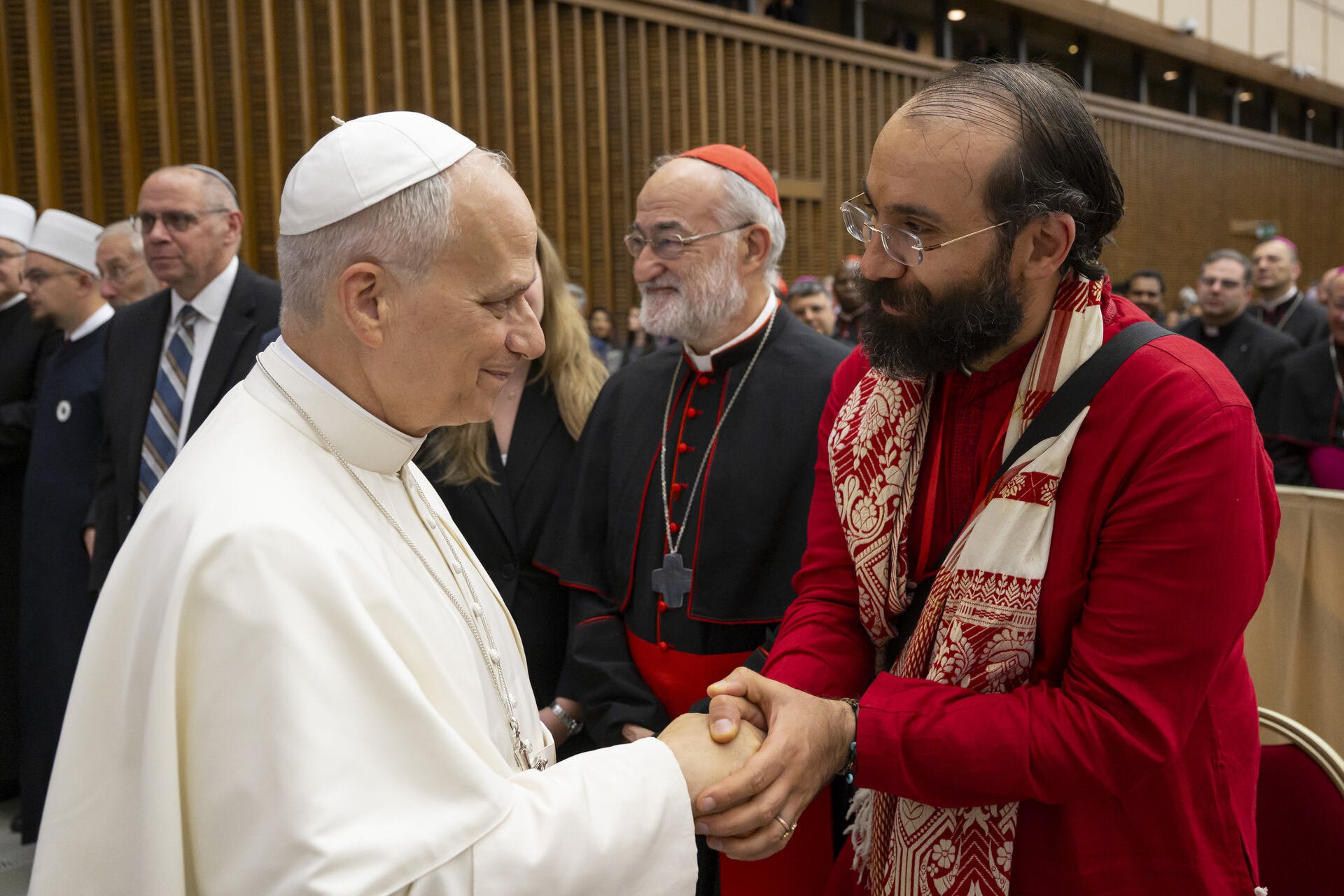
Lama Sherab Gyatso with His Holiness Pope Leo XIV. at the Vatican’s 60th Celebration of Nostra Aetate. The Pope gifted our centre three Seeds of Hope, one of which has been planted at our the centre, and one has been shared with our Lama AR. He said: “Dialogue is not a tactic or a tool, but a way of life — a journey of the heart that transforms everyone involved, the one who listens and the one who speaks.”

Kurukullā, the dancing dakini of great bliss. In 2025, our Root-Guru AR revealed that Kurukullā is present in the secret space of Yumka Queen of Great Bliss, the innermost secret dakini of the Longchen Nyingthig.